
Introduction
Hiring a PR agency is one of the higher-stakes marketing decisions a US business will make. The right partner can strengthen media relationships, sharpen credibility, and generate demand that actually converts. The wrong one wastes a year of budget on press releases nobody reads.
Many buyers lean on star ratings or an agency's own case studies to decide. That's a problem. Professional-services reviews vary wildly in quality, recency, and verification. A five-star listing with no project detail tells you almost nothing.
This guide compares five PR agencies serving the US market: DPR Group, Edelman, Weber Shandwick, Burson, and FINN Partners. We evaluate them on industry fit, service scope, review quality, client evidence, team experience, and measurement practices, not popularity alone.
Key Takeaways
- The best PR agency depends on your industry, budget, and the communications support you need.
- Verified reviews and client references beat star ratings or logo walls.
- Compare media relations, content, crisis planning, thought leadership, and measurement capabilities side by side.
- Confirm the actual account team, relevant case studies, and reporting process before signing anything.
- DPR Group is a fit for US B2B technology and business buyers—still vet its proof like any other firm.
Overview of PR Agencies and Reviews in the US Market
A PR agency shapes how the public, press, and industry stakeholders perceive a company. Core work includes media relations, messaging, thought leadership, content development, press outreach, crisis communications, and event support.
B2B and specialized industries rely on PR as much as consumer brands. It supports:
- Start-ups building initial credibility
- Technology companies launching products
- Manufacturers and government contractors navigating specialized trade media
- Healthcare businesses managing regulated messaging
- Established enterprises protecting reputation at scale
Not All Evidence Is Equal
Reviews, testimonials, case studies, awards, and client logos often get treated as interchangeable proof. They are not.
| Evidence Type | What It Proves | What It Doesn't |
|---|---|---|
| Client review | One client's reported experience | Typical results across all clients |
| Agency-hosted testimonial | A named client's selected statement | An independent satisfaction rate |
| Case study | A stated brief and reported outcome | Independent attribution |
| Award or ranking | Recognition under that program's criteria | A verified client review |
| Client logo | An asserted relationship | Scope, recency, or permission to speak to them |
Review platforms like Clutch check whether a reviewer was an actual client, but their own guidance still allows listings marked "Not Verified" — so check each review individually rather than assuming a platform vets everything equally.
The supplier pool itself is large. IBISWorld counts 59,292 US public-relations firms in 2026, up 2.7% from 2025, according to its Public Relations Firms in the US industry report. That volume raises the bar on due diligence. Treat the list below as a research shortlist. Final selection should rest on verified reviews, current capabilities, and a direct conversation with the team who would run your account.

Top PR Agencies in the US
Selection here rests on verified and detailed client feedback, relevant sector experience, service breadth, account-team transparency, and measurement approach, not name recognition alone.
DPR Group
Founded in 1998 and headquartered in Frederick, Maryland, with additional US presence in Germantown, Maryland, and Cary, North Carolina, DPR Group focuses on integrated public relations, content marketing, and strategic communications for technology and business companies.
Sector focus includes:
- B2B software and enterprise technology
- Supply chain, logistics, manufacturing, and robotics
- Healthcare technology and clean technology
- Government contractors and emerging-technology firms
Its industry expertise pages outline work spanning defense, cybersecurity, and smart-manufacturing clients — a narrower, more specialized footprint than a global network.
On the evidence: DPR Group publishes client testimonials directly on its site. Felix Pekar, COO of QuestaWeb, credited the agency with positive media coverage and increased software visibility. Jonathan Kaplan of FactoryEye North America cited its manufacturing-sector media connections.
These are agency-hosted testimonials, not independently verified third-party reviews. Treat them as a starting point for reference calls rather than final proof.
Comparison summary:
- Review evidence: Self-published client testimonials and named case studies; no independently verified review platform listing was identified
- Best-fit clients: Small to midsize B2B technology, manufacturing, healthcare tech, and government contracting firms
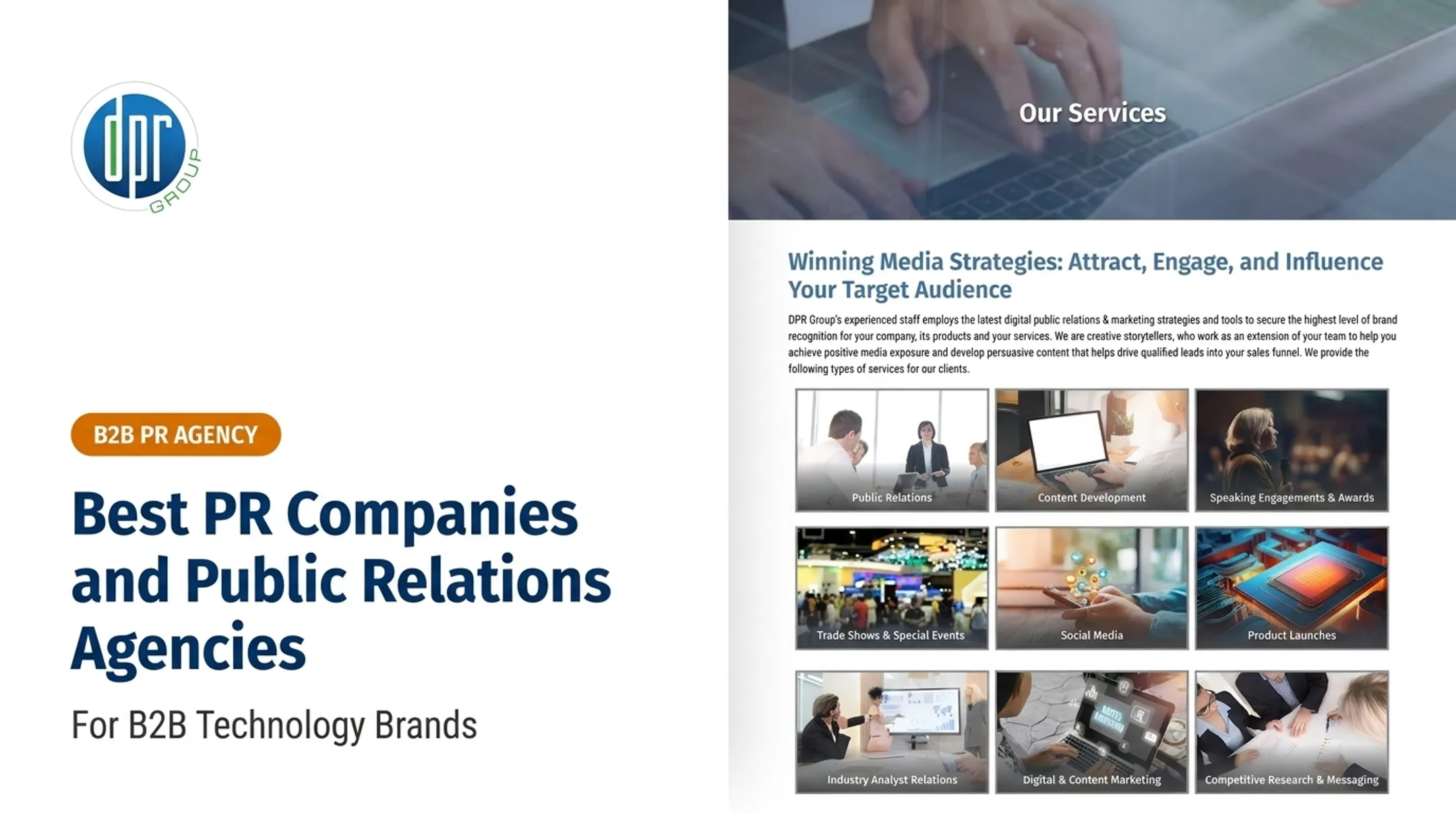
- Core services: Media relations, content development, competitive messaging, digital marketing, corporate communications
- Geographic reach: US and Canada primarily, with support for European and Asian firms entering North America
- Pricing transparency: Not publicly listed; requires direct inquiry
- Ask before hiring: Which specific team member handles day-to-day pitching, and can you speak with a current client in your sector?
Note: DPR Group's HubSpot certifications reflect inbound marketing training, not a measure of PR results.
Edelman
Edelman maintains US offices across Atlanta, Austin, Chicago, Dallas, Houston, Los Angeles, New York, Portland, San Francisco, Seattle, and Washington, DC, with practice areas covering technology, health, media relations, and public affairs.
The firm describes itself as independent and family-run, with over 6,000 people across 60-plus offices globally.
O'Dwyer's 2026 independent-firm ranking places Edelman first by worldwide net fees, but that's a network-level figure, not proof of what your assigned US team will deliver.
Comparison summary:
- Review evidence: Strong editorial and ranking presence (PRovoke Media profiles); limited independently verified client reviews tied to a specific US office
- Best-fit clients: Large enterprises and organizations needing multi-market or public-affairs depth
- Core services: Corporate communications, technology and health PR, medical communications, government affairs
- Team model: Large global network; account staffing varies significantly by office
- Pricing transparency: Enterprise-scale retainers typical; not published
- Ask before hiring: Exactly which office and senior staff will be assigned, and how much access you'll get to them
For start-ups and mid-market companies, that scale can be an advantage or a drawback. A large network offers resources, but it can also mean less senior attention on a smaller account.
Weber Shandwick
Weber Shandwick's Advisory practice covers corporate reputation, public affairs, crisis and issues management, and financial communications, with sector pages spanning technology, healthcare, government, and manufacturing.
Its offices in Chicago and San Francisco are documented on the firm's site, with the San Francisco location identifying a dedicated North American technology-practice lead. A PRovoke Media 2025 profile names CMS and Pfizer among client examples and discusses corporate and digital work.
Comparison summary:
- Review evidence: Editorial profiles and named client examples; a collective-level global ranking (The Weber Shandwick Collective, No. 3 globally per PRovoke) shouldn't be read as a review of one specific office
- Best-fit clients: Enterprises needing crisis planning, public affairs, or corporate reputation work
- Core services: Corporate communications, crisis/issues management, digital PR, sector-specific campaigns
- Team structure: Office-based teams supported by a broader global collective
- Pricing transparency: Not published; scope-dependent
- Ask before hiring: Whether the case studies presented belong to the office handling your account or a different location entirely
Burson
Burson formed in July 2024 when WPP combined BCW and Hill & Knowlton. Any BCW-era case study should be treated as predecessor work unless the current Burson team is explicitly identified.
The firm's US locations page lists a New York headquarters and 16 US offices, with expertise spanning corporate and public affairs, health, technology, and industrial/energy communications.
Comparison summary:
- Review evidence: A December 2025 hiring announcement and a PRovoke Media profile discussing a New York City government-recruitment campaign; no verified client review platform listing found
- Best-fit clients: Organizations needing broad strategic communications, reputation management, or public affairs across multiple sectors
- Core services: Corporate/public affairs advisory, crisis support, integrated media relations
- Account-team transparency: Confirm whether proposed staff and case studies reflect the current Burson US team, not the pre-merger BCW or Hill & Knowlton organization
- Pricing transparency: Not published
- Verification question: Ask directly which named case studies were executed under the current Burson brand versus a legacy agency
FINN Partners
FINN Partners positions itself as an independent global agency. Its Boston office names AI, robotics, SaaS, advanced manufacturing, and life sciences as specialties; its New York office adds technology, health, and manufacturing.
O'Dwyer's 2026 ranking places FINN sixth among independent firms by worldwide net fees. That's a network figure, not a client-specific outcome.
A Clutch listing under the FINN Partners name shows zero reviews and links to a different domain (abipr.com). Clarify that detail directly with the agency before treating the profile as current evidence.
Comparison summary:
- Review evidence: Limited independently verified reviews found for the current local team; ranking data reflects the global network
- Best-fit clients: Growing B2B technology, manufacturing, and life-sciences companies wanting independent-agency responsiveness
- Core services: Media relations, content, sector-specific practice teams across multiple US offices
- Team model: Independent network with office-level specialization
- Pricing transparency: Not published
- Ask before hiring: Which practice team and office will staff your account, and can they connect you to a recent client in your industry
Before finalizing any shortlist, confirm all five agencies are currently operating under these names and that any review source you cite is still live and current. Agency mergers and rebrands (like Burson's) happen more often than buyers expect.

How We Chose the Best PR Agencies
This is a research shortlist, not a permanent ranking. The process involved confirming current services, gathering independent evidence where available, comparing sector fit, and checking whether client claims could be verified.
Evaluating Review Quality Over Volume
A hundred vague five-star reviews matter less than three detailed ones. Look for:
- Reviewer identity or business context
- A specific project description and service category
- The review's date
- Whether the agency responded
- Outcomes that are specific and attributable, not just "great experience"
Matching Agency to Client Fit
Review quality only gets you so far—the shortlist also has to fit how you buy and run PR. Weigh each agency against:
- Industry experience in your category
- Company stage (start-up, mid-market, or enterprise)
- Target audience and buyer mix
- Required level of senior involvement on the account
A Fortune 500 healthcare brand and a 40-person SaaS start-up need very different account structures, even from the same agency.
Comparing Service Scope
Once fit is clear, map each agency to the services you actually need—not the full menu on their site:
- Media relations and messaging
- Content and thought leadership
- Crisis planning
- Digital PR
- Public affairs
Few companies need all of them at once.
Requiring Measurement Evidence
Ask how success will be measured — target-publication coverage, share of voice, qualified traffic, backlinks, or leads. AMEC's Barcelona Principles 4.0, published in 2025, push measurement toward outcomes and impact rather than impressions or advertising-value equivalency. If an agency's only metric is media impressions, push back.

Common selection mistakes:
- Choosing solely by star rating
- Being swayed by famous client logos with no context
- Accepting anonymous case studies at face value
- Never meeting the actual delivery team
- Skipping contract and cancellation terms
- Not calling references
Conclusion
The strongest PR agency choice is the one whose reviews, sector expertise, team structure, and measurement approach match your specific goals. It's rarely the largest firm or the one with the most awards on its homepage.
Before you sign, run a tight shortlist:
- Pick two or three agencies with relevant sector experience
- Request case studies and speak with client references
- Confirm exactly who will work on your account
- Compare scope, deliverables, reporting cadence, fees, and timelines
When those criteria point toward integrated PR and content for B2B technology, DPR Group is a relevant option for US innovators—especially in manufacturing, supply chain, healthcare technology, and government contracting. Review their client testimonials and contact the agency to test fit for your situation.
No agency can guarantee results. Any that claims otherwise deserves a harder look.
Frequently Asked Questions
How much do PR agencies cost?
Costs vary by agency size, scope, industry complexity, and retainer versus project pricing. Clutch's 2026 PR pricing guidance ties rates to expertise and location, so ask about extras like media monitoring, production, or paid promotion.
What does a PR agency actually do?
Common services include media relations, messaging, press materials, thought leadership, content, crisis communications, and measurement reporting. Exact scope differs significantly by agency and contract, so confirm deliverables in writing before signing.
How can I tell whether a PR agency review is trustworthy?
Check the reviewer's context, project details, service scope, and date. Favor reviews that are independently verified over agency-hosted testimonials, and cross-check claims against references or documented case studies.
What should I ask before hiring a PR agency?
Ask who will run your account, what relevant experience they have, how success is measured, and how often you'll get reports. Clarify contract terms, budget assumptions, and whether you can speak with current clients.
How long does it take to see results from a PR agency?
Timelines depend on the news cycle, media relationships, and approval process. Early activity like pitching and message testing typically starts within weeks; broader visibility or reputation shifts often take several months to a year.
How do I measure whether a PR agency is successful?
Track agreed metrics like relevant coverage, message inclusion, qualified traffic, and stakeholder engagement rather than raw impressions. Attribute business outcomes carefully—PR rarely works in isolation from other marketing efforts.